

Candice Hoyes Illuminates the Life of Librarian Belle da Costa Greene at the Logan Center
By Andrea Reed-Leal, PhD Candidate Hispanic and Luso-Brazilian Studies
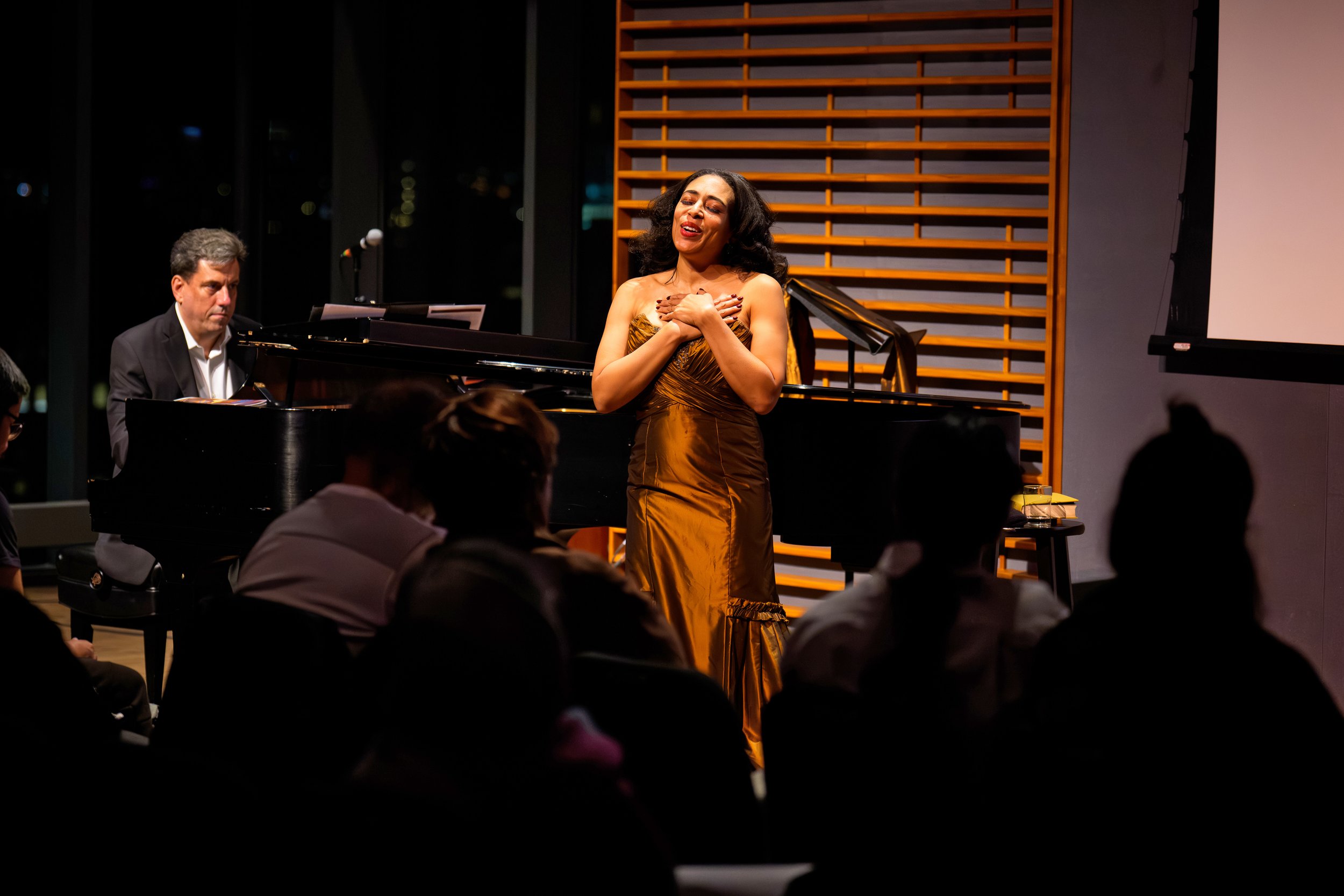
Photo by Jason Smith
Presented by the Logan Center for the Arts in partnership with The Black Baroque Project and UChicago Library
In a recital that blended archival work, storytelling, and music, the soprano and composer Candice Hoyes and pianist Christopher Cooley gave a memorable performance on Wednesday, October 29, at the Logan Center for the Arts.
Their program, Belle Canto, celebrated Belle da Costa Greene, the pioneering librarian who managed financier J. P. Morgan’s collection in the early 20th century and helped establish what became The Morgan Library & Museum. Greene, born to Black parents, lived her professional life passing for white, a fact she concealed to navigate the racial hierarchies of her time.
Hoyes and Cooley brought Greene’s remarkable life to the stage through music that spanned more than a century of Black American music. An award-winning soprano, Hoyes is known for connecting archives and music, bringing hidden histories to life through performance.
Hoyes approached Greene’s story like an archivist—reading from her letters, telling us about Greene’s own passion for opera. She framed the recital with reflections on Greene’s fascination with opera: Giacomo Puccini’s Sogno d’Or and Claude Debussy’s Ariettés oubliées L. 60 being her favorites. And the selections formed a historical arc.
Florence Price’s Bewilderment, set to a poem by Langston Hughes, opened with warmth and gravity, grounding the program in Price’s pioneering role as the first Black woman composer to have a symphony performed by a major U.S. orchestra. From there, Hoyes moved through H. Leslie Adams, whose Creole Girl explores multiplicity within the Black diaspora, and Ricky Ian Gordon’s setting of Dorothy Parker’s The Satin Dress, a witty miniature of longing and defiance.
It was a very unique experience to hear how Hoyes used her voice to connect music with history and the archive. When she referenced Elizabeth Taylor Greenfield, the 19th-century soprano who became the first Black artist to perform at Buckingham Palace, she placed Greene’s world within a larger lineage of Black artistry.
Near the end of the recital, Hoyes performed her own composition, Zora’s Moon, inspired by writer and anthropologist Zora Neale Hurston. She has described the piece elsewhere as an “ode to Black girlhood.” It grounded the program in the present, linking Greene’s hidden life to Hoyes’s feminist and racial justice activism.
Belle Canto was a true honor to hear at the Logan Center.